


Scientific name:
Plant family:
Common name:
Lao name:
Uvaria rufa Blume
Annonaceae
Carabao Teats
phi phouane, tin tang
In the Annonaceae family, the Uvaria genus is one of the most important, unfortunately these are rare plants in cultivation and difficult to find in their natural environment because they survive in what remains of humid forests in Southeast Asia as far as the Philippines and perhaps in New Zealand. In the Indochinese peninsula, about twenty species have been listed and in Laos about fifteen. Among these, Uvaria rufa is one of the most common. It is a lianescent shrub of dense forest with hairy branches. Its leaves are rough to the touch on top, with soft hairs underneath. Its fragrant flowers are sometimes solitary, sometimes grouped by 2 or 3; they are regular with 6 dark red petals around a yellowish globular heart. Its fruits, round or elongated, are red when ripe, velvety with whitish pulp, acidulous, edible; they are grouped in a cluster, a bit like that of grapes, uva in Latin.
The Lao call this vine kheua phi Phouane, a name that can be translated as “liana of the big Phouane”, in reference to an ethnic group from the north of the country; in the east we also say mak tin tang. In Thai, in Cambodia we refer to the monkey, ham ling “monkey testicles”. The English name means “nipple of Carabao” which is a buffalo from the Philippines.
Opinions are divided as to the flavor of the fruits, the Lao find them deliciously acidic while a French friend speaks of a taste that is “between unripe orange and lemon… it is an impression of extreme acidity that fills your mouth”.
Mak phi phouane is a vine that is sometimes used when rattan is lacking; but it is also a medicinal plant used especially for young women who have given birth, a decoction of the roots would give them tone and would also be good for their milk. But this decoction is also given in case of fever. The fruits crushed in water are applied to relieve itching.
We cannot talk about mak phi phouane without talking about a very similar species with an evocative name: kam lang seua khong, “strength of the royal tiger” which enjoys, according to Vidal, “a great reputation as a tonic and aphrodisiac”; and if you ask the Lao they will tell you the same thing in a more disguised way. The difficulty is that the plant corresponding to this name is poorly identified, botanists having given it several names: Uvaria micrantha or Cyathostemma micranthum. In any case, it is included in many tonic and revitalizing recipes not only in Laos but also in Thailand and Malaysia. However, no pharmacological study has been carried out to date, but in this area the suggestion is very effective
Dans la famille des Annonacées le genre Uvaria est l’un des plus importants, malheureusement ce sont des plantes rares en culture et difficile à trouver dans leur milieu naturel car ils subsistent dans ce qui reste encore de forêts humides en Asie du Sud Est jusqu’aux Philippines et peut-être en Nouvelle Zélande. Dans la péninsule indochinoise on a répertorié environ une vingtaine d’espèces et au Laos une quinzaine. Parmi celles-ci Uvaria rufa est l’une des plus courantes.
C’est un arbuste lianescent de forêt dense aux rameaux velus. Ses feuilles sont rudes au toucher en dessus, à poils mous en dessous. Ses fleurs parfumées sont parfois solitaires, parfois groupées par 2 ou 3; elles sont régulières à 6 pétales rouge foncé autour d’un cœur globuleux jaunâtre. Ses fruits, ronds ou allongés, sont rouges à maturité, veloutés à pulpe blanchâtre, acidulée, comestible; ils sont groupés en grappe, un peu comme celle du raisin, uva en latin.
Les Lao nomment cette liane kheua phi Phouane, nom que l’on peut traduire par « liane des gros Phouane », par référence à une ethnie du nord du pays; dans l’est on dit également mak tin tang. En thaï, en cambodgien on fait référence au singe, ham ling « testicules de singe ». Le nom anglais signifie « téton de Carabao » qui est un buffle des Philippines.
Les avis sont partagés quant à la saveur des fruits, les Lao les trouvent délicieusement acides alors qu’un ami français parle d’un goût qui se « situe entre l’orange pas mûre et le citron…c’est une impression d’extrême acidité qui vous remplit la bouche ».
Mak phi phouane est une liane qui est parfois utilisée quand le rotin fait défaut; mais c’est également une plante médicinale utilisée surtout pour les jeunes accouchées, une décoction des racines leur donnerait du tonus et serait en outre bonne pour leur lait. Mais on donne également cette décoction en cas de fièvre. Les fruits écrasés dans l’eau sont appliqués pour soulager les démangeaisons.
On ne peut parler de mak phi phouane sans parler d’une espèce très voisine au nom évocateur: kam lang seua khong, « force du tigre royal » qui jouit nous dit Vidal «d’une grande réputation comme tonique et aphrodisiaque »; et si vous interrogez les Lao on vous dira la même chose de façon plus déguisée. La difficulté c’est que la plante correspondant à ce nom est mal identifiée, les botanistes lui ayant donné plusieurs noms: Uvaria micrantha ou Cyathostemma micranthum. Elle entre en tous les cas dans de nombreuses recettes toniques et revitalisantes non seulement au Laos mais également en Thaïlande et en Malaisie. Cependant aucune étude pharmacologique n’a été faite à ce jour, mais en la matière la suggestion est très efficace.
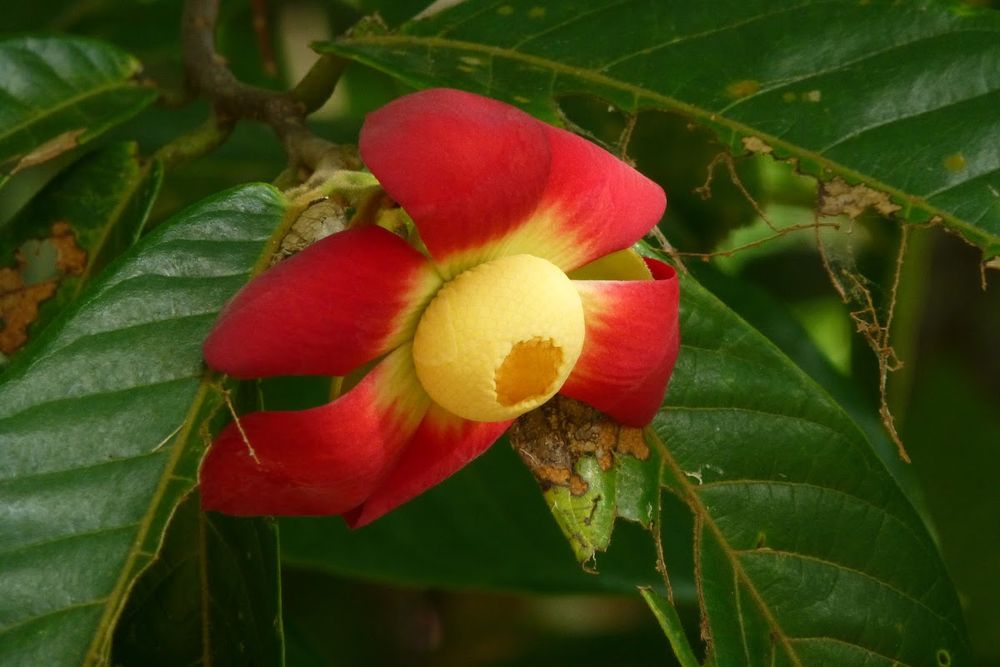
The fragrant flower has beautiful dark red petals

Fruits like bunches of grapes
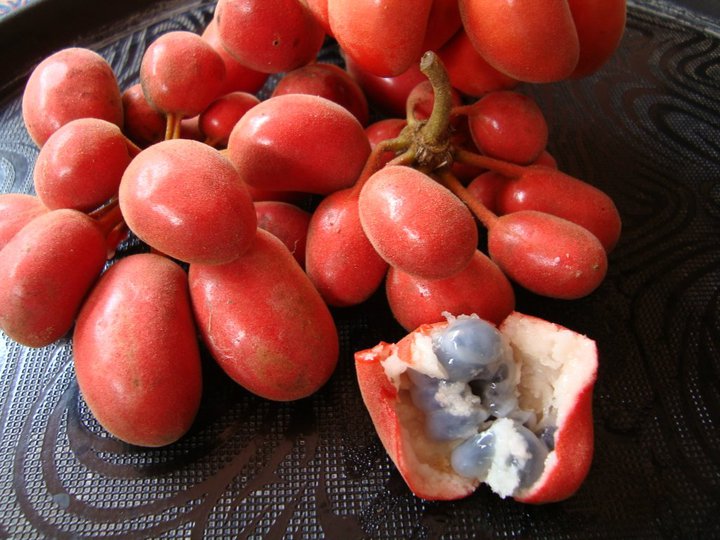
Mak phi phouane fruits are sometimes sold at the market

Kam lang seua khong
Scientific name:
Uvaria rufa Blume
Plant family:
Annonaceae
Common name:
Carabao Teats
Lao name:
phi phouane, tin tang
In the Annonaceae family, the Uvaria genus is one of the most important, unfortunately these are rare plants in cultivation and difficult to find in their natural environment because they survive in what remains of humid forests in Southeast Asia as far as the Philippines and perhaps in New Zealand. In the Indochinese peninsula, about twenty species have been listed and in Laos about fifteen. Among these, Uvaria rufa is one of the most common. It is a lianescent shrub of dense forest with hairy branches. Its leaves are rough to the touch on top, with soft hairs underneath. Its fragrant flowers are sometimes solitary, sometimes grouped by 2 or 3; they are regular with 6 dark red petals around a yellowish globular heart. Its fruits, round or elongated, are red when ripe, velvety with whitish pulp, acidulous, edible; they are grouped in a cluster, a bit like that of grapes, uva in Latin.
The Lao call this vine kheua phi Phouane, a name that can be translated as “liana of the big Phouane”, in reference to an ethnic group from the north of the country; in the east we also say mak tin tang. In Thai, in Cambodia we refer to the monkey, ham ling “monkey testicles”. The English name means “nipple of Carabao” which is a buffalo from the Philippines.
Opinions are divided as to the flavor of the fruits, the Lao find them deliciously acidic while a French friend speaks of a taste that is “between unripe orange and lemon… it is an impression of extreme acidity that fills your mouth”.
Mak phi phouane is a vine that is sometimes used when rattan is lacking; but it is also a medicinal plant used especially for young women who have given birth, a decoction of the roots would give them tone and would also be good for their milk. But this decoction is also given in case of fever. The fruits crushed in water are applied to relieve itching.
We cannot talk about mak phi phouane without talking about a very similar species with an evocative name: kam lang seua khong, “strength of the royal tiger” which enjoys, according to Vidal, “a great reputation as a tonic and aphrodisiac”; and if you ask the Lao they will tell you the same thing in a more disguised way. The difficulty is that the plant corresponding to this name is poorly identified, botanists having given it several names: Uvaria micrantha or Cyathostemma micranthum. In any case, it is included in many tonic and revitalizing recipes not only in Laos but also in Thailand and Malaysia. However, no pharmacological study has been carried out to date, but in this area the suggestion is very effective
Dans la famille des Annonacées le genre Uvaria est l’un des plus importants, malheureusement ce sont des plantes rares en culture et difficile à trouver dans leur milieu naturel car ils subsistent dans ce qui reste encore de forêts humides en Asie du Sud Est jusqu’aux Philippines et peut-être en Nouvelle Zélande. Dans la péninsule indochinoise on a répertorié environ une vingtaine d’espèces et au Laos une quinzaine. Parmi celles-ci Uvaria rufa est l’une des plus courantes.
C’est un arbuste lianescent de forêt dense aux rameaux velus. Ses feuilles sont rudes au toucher en dessus, à poils mous en dessous. Ses fleurs parfumées sont parfois solitaires, parfois groupées par 2 ou 3; elles sont régulières à 6 pétales rouge foncé autour d’un cœur globuleux jaunâtre. Ses fruits, ronds ou allongés, sont rouges à maturité, veloutés à pulpe blanchâtre, acidulée, comestible; ils sont groupés en grappe, un peu comme celle du raisin, uva en latin.
Les Lao nomment cette liane kheua phi Phouane, nom que l’on peut traduire par « liane des gros Phouane », par référence à une ethnie du nord du pays; dans l’est on dit également mak tin tang. En thaï, en cambodgien on fait référence au singe, ham ling « testicules de singe ». Le nom anglais signifie « téton de Carabao » qui est un buffle des Philippines.
Les avis sont partagés quant à la saveur des fruits, les Lao les trouvent délicieusement acides alors qu’un ami français parle d’un goût qui se « situe entre l’orange pas mûre et le citron…c’est une impression d’extrême acidité qui vous remplit la bouche ».
Mak phi phouane est une liane qui est parfois utilisée quand le rotin fait défaut; mais c’est également une plante médicinale utilisée surtout pour les jeunes accouchées, une décoction des racines leur donnerait du tonus et serait en outre bonne pour leur lait. Mais on donne également cette décoction en cas de fièvre. Les fruits écrasés dans l’eau sont appliqués pour soulager les démangeaisons.
On ne peut parler de mak phi phouane sans parler d’une espèce très voisine au nom évocateur: kam lang seua khong, « force du tigre royal » qui jouit nous dit Vidal «d’une grande réputation comme tonique et aphrodisiaque »; et si vous interrogez les Lao on vous dira la même chose de façon plus déguisée. La difficulté c’est que la plante correspondant à ce nom est mal identifiée, les botanistes lui ayant donné plusieurs noms: Uvaria micrantha ou Cyathostemma micranthum. Elle entre en tous les cas dans de nombreuses recettes toniques et revitalisantes non seulement au Laos mais également en Thaïlande et en Malaisie. Cependant aucune étude pharmacologique n’a été faite à ce jour, mais en la matière la suggestion est très efficace.
The fragrant flower has beautiful dark red petals
Fruits like bunches of grapes
Mak phi phouane fruits are sometimes sold at the market
Kam lang seua khong
The fragrant flower has beautiful dark red petals
Fruits like bunches of grapes
Mak phi phouane fruits are sometimes sold at the market
Kam lang seua khong
Scientific name:
Uvaria rufa Blume
Plant family:
Annonaceae
Common name:
Carabao Teats
Lao name:
phi phouane, tin tang
In the Annonaceae family, the Uvaria genus is one of the most important, unfortunately these are rare plants in cultivation and difficult to find in their natural environment because they survive in what remains of humid forests in Southeast Asia as far as the Philippines and perhaps in New Zealand. In the Indochinese peninsula, about twenty species have been listed and in Laos about fifteen. Among these, Uvaria rufa is one of the most common. It is a lianescent shrub of dense forest with hairy branches. Its leaves are rough to the touch on top, with soft hairs underneath. Its fragrant flowers are sometimes solitary, sometimes grouped by 2 or 3; they are regular with 6 dark red petals around a yellowish globular heart. Its fruits, round or elongated, are red when ripe, velvety with whitish pulp, acidulous, edible; they are grouped in a cluster, a bit like that of grapes, uva in Latin.
The Lao call this vine kheua phi Phouane, a name that can be translated as “liana of the big Phouane”, in reference to an ethnic group from the north of the country; in the east we also say mak tin tang. In Thai, in Cambodia we refer to the monkey, ham ling “monkey testicles”. The English name means “nipple of Carabao” which is a buffalo from the Philippines.
Opinions are divided as to the flavor of the fruits, the Lao find them deliciously acidic while a French friend speaks of a taste that is “between unripe orange and lemon… it is an impression of extreme acidity that fills your mouth”.
Mak phi phouane is a vine that is sometimes used when rattan is lacking; but it is also a medicinal plant used especially for young women who have given birth, a decoction of the roots would give them tone and would also be good for their milk. But this decoction is also given in case of fever. The fruits crushed in water are applied to relieve itching.
We cannot talk about mak phi phouane without talking about a very similar species with an evocative name: kam lang seua khong, “strength of the royal tiger” which enjoys, according to Vidal, “a great reputation as a tonic and aphrodisiac”; and if you ask the Lao they will tell you the same thing in a more disguised way. The difficulty is that the plant corresponding to this name is poorly identified, botanists having given it several names: Uvaria micrantha or Cyathostemma micranthum. In any case, it is included in many tonic and revitalizing recipes not only in Laos but also in Thailand and Malaysia. However, no pharmacological study has been carried out to date, but in this area the suggestion is very effective
Dans la famille des Annonacées le genre Uvaria est l’un des plus importants, malheureusement ce sont des plantes rares en culture et difficile à trouver dans leur milieu naturel car ils subsistent dans ce qui reste encore de forêts humides en Asie du Sud Est jusqu’aux Philippines et peut-être en Nouvelle Zélande. Dans la péninsule indochinoise on a répertorié environ une vingtaine d’espèces et au Laos une quinzaine. Parmi celles-ci Uvaria rufa est l’une des plus courantes.
C’est un arbuste lianescent de forêt dense aux rameaux velus. Ses feuilles sont rudes au toucher en dessus, à poils mous en dessous. Ses fleurs parfumées sont parfois solitaires, parfois groupées par 2 ou 3; elles sont régulières à 6 pétales rouge foncé autour d’un cœur globuleux jaunâtre. Ses fruits, ronds ou allongés, sont rouges à maturité, veloutés à pulpe blanchâtre, acidulée, comestible; ils sont groupés en grappe, un peu comme celle du raisin, uva en latin.
Les Lao nomment cette liane kheua phi Phouane, nom que l’on peut traduire par « liane des gros Phouane », par référence à une ethnie du nord du pays; dans l’est on dit également mak tin tang. En thaï, en cambodgien on fait référence au singe, ham ling « testicules de singe ». Le nom anglais signifie « téton de Carabao » qui est un buffle des Philippines.
Les avis sont partagés quant à la saveur des fruits, les Lao les trouvent délicieusement acides alors qu’un ami français parle d’un goût qui se « situe entre l’orange pas mûre et le citron…c’est une impression d’extrême acidité qui vous remplit la bouche ».
Mak phi phouane est une liane qui est parfois utilisée quand le rotin fait défaut; mais c’est également une plante médicinale utilisée surtout pour les jeunes accouchées, une décoction des racines leur donnerait du tonus et serait en outre bonne pour leur lait. Mais on donne également cette décoction en cas de fièvre. Les fruits écrasés dans l’eau sont appliqués pour soulager les démangeaisons.
On ne peut parler de mak phi phouane sans parler d’une espèce très voisine au nom évocateur: kam lang seua khong, « force du tigre royal » qui jouit nous dit Vidal «d’une grande réputation comme tonique et aphrodisiaque »; et si vous interrogez les Lao on vous dira la même chose de façon plus déguisée. La difficulté c’est que la plante correspondant à ce nom est mal identifiée, les botanistes lui ayant donné plusieurs noms: Uvaria micrantha ou Cyathostemma micranthum. Elle entre en tous les cas dans de nombreuses recettes toniques et revitalisantes non seulement au Laos mais également en Thaïlande et en Malaisie. Cependant aucune étude pharmacologique n’a été faite à ce jour, mais en la matière la suggestion est très efficace.